Smashy Road: Wanted 2
- 4.0
- Rating
- 10.00M
- Installs
- Free
- Price

 Analysis by App-foxy
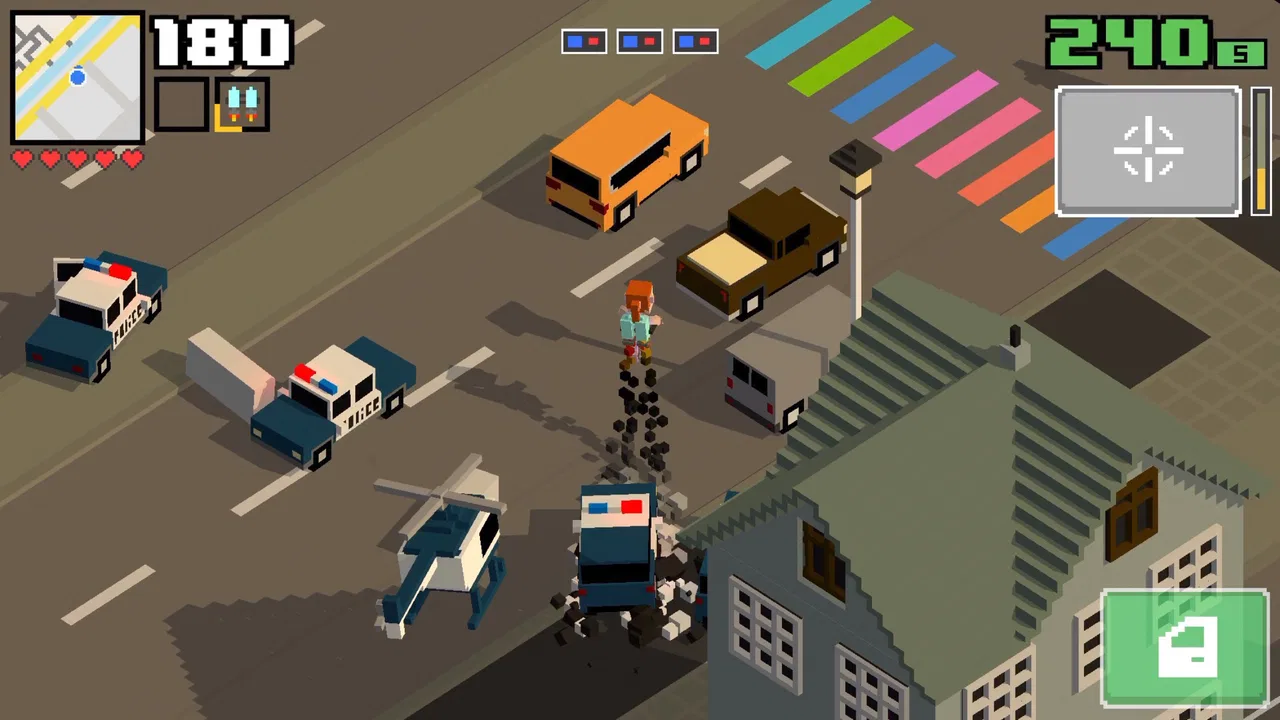
I expected Smashy Road: Wanted 2 to be a simple chase game, and it is, but the first few seconds already explain why it has kept me coming back. I start by driving through a compact, busy-looking world while police vehicles close in, then I make quick decisions about turns, obstacles, open space, and how much danger I can tolerate. There is no long tutorial to get through before the action begins. The game puts me in motion quickly, and that makes every attempt feel easy to start.
This is a free action game from Bearbit Studios B.V. for players aged Everyone 10+, with support for Android 7.0 and later. Its basic idea is wonderfully clear: I am wanted, I need to stay on the run, and every extra moment creates another chance to lose control. That clarity matters on a phone. I can play for a short break without having to remember a complicated story or rebuild a large strategy from a previous session.
After spending time with it, I see the appeal as a tight loop rather than a deep driving simulator. I act, receive immediate feedback from the chase, earn reasons to continue, eventually get caught or crash, and then restart with the thought that the next run could be cleaner. That structure is the real product. It is also the main question to ask before downloading: do you enjoy improving through repeated short attempts, or do you need a campaign with a slower sense of progress?
You May Also Like

 Blood Strike: 2.5 Anniversary
Blood Strike’s Loadouts Turn Every Drop Into a Tactical Gamble
A close look at Blood Strike’s custom loadouts: how fast access to signature weapons reshapes its battle royale rhythm, rewards preparation, and narrows the gap between fights.

 Pandora - Music & Podcasts
Pandora’s Music Is Easy to Start, but Harder to Recover
Pandora’s strength is its low-effort path from a seed to a station. Its weak spot is how much confidence it asks you to place in connection, setup, and quiet recovery.

 8 Ball Pool
 Is Built on Rivalries, Rematches, and Routine
A close look at the rivalries, rematches, shared routines, and unanswered safety questions that turn a quick pool match into a persistent mobile community.

 Samsung Music
’s Quiet Strength Is Playing What You Already Own
Its reach comes less from spectacle than from dependable access to a personal library. That simplicity is both the app’s strongest retention engine and its ceiling.

 AccuWeather: Weather Radar
AccuWeather Review: A Quick, Clear Forecast for Everyday Decisions
For everyday plans, the best forecast is the one you can understand quickly. AccuWeather makes rain timing, radar, and local conditions easy to act on, with a few trade-offs.

 Hill Climb Racing
Why Hill Climb Racing Still Turns Crashes Into One More Run
A tiny car, a bumpy hill and one more upgrade: Hill Climb Racing keeps resurfacing because its simple chaos makes every near-miss feel personal.
More From Our News Desk



How the chase turns one move into another
I find that the chase becomes more interesting when I treat each turn as a choice about what I want to preserve: speed, space, or a way out. A quick route can save the moment but leave fewer options afterward, so I try to think one move beyond the obstacle in front of me. Next, I’ll look at the small setup checks that can help keep a run from being interrupted for reasons unrelated to the chase.
The first action is deliberately uncomplicated
The opening moments are about steering, not studying. I am not asked to learn a large set of controls before enjoying the game. The important skill is reading the space ahead and choosing a route before the pursuit forces the issue. A turn that looks safe can become a trap when a vehicle blocks the exit, while a risky gap may be the only way to create distance.
That makes the driving feel more like quick problem-solving than ordinary racing. In a traditional racing game, I usually focus on an ideal line around a fixed track. Here, the pressure comes from reacting to a changing situation. I am not simply trying to be fastest around a circuit; I am trying to remain mobile while the world and the pursuing vehicles make each decision less comfortable.
For a new player, my practical advice is to avoid treating the accelerator as the whole game. Survival improves when I look farther ahead, leave room for a correction, and resist turning sharply just because a pursuer appears nearby. Early runs are useful for learning how much space the vehicle needs to change direction. That small adjustment is more valuable than trying to make every move dramatic.
The controls also give the game a low barrier to entry. Someone can understand the goal almost immediately, which is helpful when playing on a phone during a commute or while waiting for an appointment. At the same time, simple controls do not mean simple decisions. Once the chase becomes crowded, a familiar movement can produce a very different result depending on timing and position.
Feedback arrives through pressure rather than explanation
The strongest feedback is the pursuit itself. When I make a good escape, I feel it because the immediate danger changes. When I misjudge a corner, the consequence is just as clear. The game does not need a long message to tell me that I made a poor choice; the sudden loss of room, collision, or capture communicates it instantly.
This rhythm keeps the action readable. I am constantly switching between confidence and caution. A few successful turns make me want to push farther, but that confidence can become the reason I take a needless risk. The chase creates a natural rise in tension without requiring a complicated plot or a large collection of objectives.
One useful habit is to separate escape decisions from score-chasing decisions. When I am still learning a vehicle or a route, I focus on staying alive rather than forcing a spectacular maneuver. Once I understand how the car responds, I can take more calculated risks. This approach makes the game less frustrating because failure becomes information: I learn whether I turned too early, entered a narrow area without an exit, or let the pursuit dictate every move.
The feedback is immediate, but it is not always gentle. Players who dislike losing because of one bad turn may find the chase irritating, especially when a run has already lasted long enough to feel valuable. I sometimes reach the point where I know exactly what I should have done, yet the game gives me no opportunity to undo it. That is part of the tension, although it can also be the biggest source of friction.
Rewards give the next attempt a purpose
The game is more effective when I view rewards as fuel for experimentation rather than as a promise of a long-form adventure. Finishing a run with a better result gives me a reason to try again, and the chase itself encourages me to test different ways of handling danger. The reward is not only what appears after an attempt; it is also the knowledge gained from surviving a situation that defeated me before.
That distinction is important because this is not the right choice for someone who wants a carefully paced story campaign. Its pleasure comes from repeating the central activity and gradually becoming more comfortable with it. I enjoy seeing whether a better opening decision can extend a run, whether a different route keeps me out of trouble, and whether I can stay calm when several threats appear at once.
There are optional in-app purchases priced from $0.99 to $18.99 per item. The game can be downloaded and played for free, so I would begin without spending anything and first decide whether the chase loop holds my attention. That is especially sensible here because the core question is personal: if repeated escapes and resets already feel satisfying, additional content may be appealing; if the basic pursuit feels repetitive, paying will not change the underlying style of play.
I also appreciate that the free entry point makes it easier to recommend to a friend cautiously. I can say, “Try a few runs and see whether the pressure works for you,” rather than suggesting a purchase before the controls and pacing have had a chance to make their case. The game’s average rating is 4.0 from around 105 thousand ratings, and it has passed 10 million installs, which fits my impression that its straightforward loop has broad reach without making it universally suitable.
Resetting is not a pause in the design; it is the design
Eventually, a run ends. I get caught, lose control, or make a decision that cannot be recovered. The reset is quick enough that failure does not become a long interruption. Instead of returning to a menu and wondering what to do next, I am usually already thinking about the mistake and how to avoid it in the following attempt.
This is where the game’s strongest psychological trick appears. A failed run often contains just enough progress to make another attempt feel reasonable. I was close to escaping a difficult situation, found a promising route, or simply made it farther than before. The reset turns that unfinished feeling into motivation. I do not restart because the game asks me to; I restart because I believe one small improvement might change the result.
That loop works best in short sessions. I can play when I have only a few minutes, stop after an unsuccessful attempt, and return later without needing to reconstruct a complicated objective. It also works for longer sessions when I am chasing a personal improvement. The danger is that “one more run” can become repetitive if I stop learning from each failure. My solution is to give each attempt a small focus, such as smoother turns or better awareness of escape space, instead of judging every run only by its final distance.
Players who prefer permanent progress may need to adjust their expectations. A reset removes the immediate situation, so the emotional payoff is tied to skill, discovery, and whatever rewards the game provides rather than to completing a conventional level sequence. That can feel liberating when I want instant action, but thin when I am looking for a strong sense of narrative advancement.
What makes the loop different from ordinary mobile racing
Compared with a standard racing game, this is less about clean laps, braking points, and finishing ahead of a field. Compared with a traditional endless runner, the movement feels more like piloting a vehicle through a pursuit than following a fixed lane pattern. The important question is not simply how fast I can go, but whether I can turn pressure into an escape route.
That difference gives it a useful place among mobile action games. It suits players who want the immediacy of arcade driving but do not want to commit to a full race. It is also more approachable than a driving game built around detailed simulation, because I can concentrate on reactions and positioning instead of tuning a vehicle or learning realistic handling.
On the other hand, people who want precise competitive racing may prefer a game with dedicated tracks and more consistent conditions. Someone who wants an endless runner with extremely predictable patterns may also find the chase less comfortable because the best decision depends on what is happening around the vehicle. The game’s identity comes from that uncertainty, so choosing it means accepting that not every failure will feel perfectly controllable.
Small techniques that improve a run
My first concrete tip is to preserve options. When I enter a tight area, I try not to commit to a turn unless I can see where the vehicle will go next. A route that looks open for one second may leave me boxed in immediately afterward. Keeping a little space for correction is often more useful than taking the shortest visible path.
Second, I pay attention to the difference between escaping and merely moving. Forward motion can feel productive while actually carrying me toward a dead end. I now ask whether a turn creates distance or only delays the same threat. That simple check reduces the number of runs lost to panic driving.
Third, I use early attempts as controlled tests. Rather than treating every run as a serious record attempt, I deliberately explore how much risk I can take in a particular situation. This is a better way to learn than repeating the same safe opening forever, because the game rewards understanding how the chase reacts to my choices.
Finally, I stop after a run when I notice that I am repeating the same mistake without thinking. The game’s quick restart makes it easy to play while frustrated, but frustration narrows my attention and encourages desperate turns. A short break often helps more than immediately pressing the restart button again.
Who will enjoy it, and who should skip it?
I would recommend it to someone who likes arcade action, quick restarts, and games where improvement comes from better reactions rather than lengthy preparation. It is particularly suitable for casual sessions because the objective is obvious and the action starts quickly. It also works well for players who enjoy testing their own limits and turning a near-miss into a reason for another attempt.
I would be more cautious recommending it to a player who needs a strong story, a fixed campaign, or a sense that every session permanently advances a character. The repeated chase can feel narrow if the central question—how long can I remain free?—does not appeal to you. Players sensitive to sudden failure may also find the reset cycle tiring, especially after a promising run ends because of one bad decision.
The age guidance of Everyone 10+ makes it a reasonable option for many younger players, although I would still consider whether the chase intensity and optional purchases fit the person using the device. For adults, the main concern is less complexity than repetition. The game is easy to understand, but its lasting appeal depends on whether repeating the same basic challenge continues to feel rewarding.
Device expectations and the practical download decision
The current version is 1.53, and the Android requirement begins at version 7.0. That makes it accessible to a wide range of Android devices, at least from the operating-system perspective. I would still leave some room for the game to run comfortably, especially if I am playing on an older phone where touch response or general performance already feels inconsistent.
Because the game is free, my advice is simple: install it for the loop, not for the promise of a large adventure. Give yourself enough attempts to learn the steering and observe how the pursuit changes your choices. If the reset makes you curious rather than annoyed, it has probably found its audience. If you are already bored by the third or fourth attempt, the game’s central structure is unlikely to transform into something completely different later.
Bearbit Studios B.V. has kept the concept focused, and that focus is both its strength and its boundary. There is no need to decode a large system before having fun, but there is also less variety in the moment-to-moment objective than I would expect from a full racing or action campaign. Knowing that before downloading helps set the right expectations.
My verdict on action, feedback, reward, and reset
What keeps me playing is the clean sequence: I make a move, the chase reacts, I learn from the result, and the next attempt begins before the tension has completely disappeared. The reward is the feeling that a small improvement can produce a much longer escape. The reset is fast, but it does not feel meaningless when I use it to test a new decision rather than blindly repeat the old one.
That makes this a convincing free action game for short, repeatable sessions. It is not a replacement for a full racing game, a story-driven adventure, or a highly predictable runner. Instead, it offers a compact arcade challenge built around pressure and recovery. I recommend trying it without spending money first, learning to protect escape options, and judging it by how much the next run pulls you back in.
My final view is positive, with one clear condition: Smashy Road: Wanted 2 is at its best when you enjoy the chase more than the destination. If another attempt sounds appealing after a run goes wrong, the loop has real staying power. If you need every session to unlock a new chapter or deliver a permanent accomplishment, a different action game will probably suit you better.
FAQs for Smashy Road: Wanted 2
01What is Smashy Road: Wanted 2?
Smashy Road: Wanted 2 is an arcade driving and police-escape game for Android and iOS. You drive through open areas, avoid law enforcement, collect vehicles, unlock characters, and complete missions while trying to survive increasingly intense pursuits. Its simple controls make it easy to start, but escaping successfully becomes challenging as more police units and obstacles appear.
02Is Smashy Road: Wanted 2 free to download and play?
Yes, Smashy Road: Wanted 2 can generally be downloaded and played for free. However, the game may include advertisements and optional in-app purchases, depending on the platform and current version. Purchases can help unlock content or provide additional benefits, but they are not necessarily required to enjoy the main driving and chase gameplay.
03Does Smashy Road: Wanted 2 require an internet connection?
The core gameplay of Smashy Road: Wanted 2 is designed to be playable offline, which makes it convenient for short sessions while traveling or when a stable connection is unavailable. Nevertheless, internet access may be needed for advertisements, certain rewards, updates, cloud-related features, or purchases. Availability can vary according to your device and the installed version.
04What can you unlock in Smashy Road: Wanted 2?
The game includes a broad collection of vehicles, characters, and other gameplay content to discover. Unlocks can change how you approach chases, with different vehicles offering varied handling, speed, durability, or special abilities. Progress usually comes from playing, completing objectives, collecting rewards, and sometimes using optional purchases, so experimentation is an important part of the experience.
05Is Smashy Road: Wanted 2 suitable for children?
Smashy Road: Wanted 2 uses colorful, cartoon-style visuals and straightforward arcade mechanics, without realistic violence or complicated controls. It may be suitable for many younger players, but parents should still review the game’s advertising, in-app purchase options, and device permissions. Because the game can encourage repeated play and includes chase-themed action, parental guidance is recommended for children.
Pros
- Simple controls make it easy to start playing immediately.
- Large open-world maps offer plenty of room for exploration.
- Vehicle and character variety adds meaningful replay value.
- Short sessions work well for quick mobile gaming breaks.
- Offline play lets you enjoy the game without an internet connection.
Cons
- Frequent pursuits can feel repetitive after extended play sessions.
- Random unlocks may make collecting specific vehicles frustrating.
- Some objectives are difficult to complete without repeated attempts.
- Visual effects can become distracting during crowded police chases.
- Optional purchases may appeal to players wanting faster progression.

Smashy Road: Wanted 2
Gallery